The Renoir exhibition is the one I’m most looking forward to in 2026. It’s called Renoir and Love, and it will open at the Musée d’Orsay in Paris in March, move to London’s National Gallery in October, and then finish at Boston’s Museum of Fine Arts in 2027.
I’ve been following announcements for this exhibition for months, and I love that it’s not just another “greatest hits” gathering of Renoir’s most famous works. Instead, the curators are asking us to see him in a fresh way, through the theme of love. Not only romance, but also friendship, family, the playful bonds of children, and the joy of people simply spending time together. Honestly, could there be a more perfect theme for Renoir? If you plan trips around art, like I do, this is the exhibition to circle on your calendar.
Who Was Renoir? A Quick Refresher
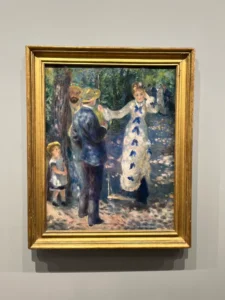
Pierre-Auguste Renoir (1841–1919) is often described as the Impressionist of joy, and I think that captures him perfectly. While Monet chased fleeting light across landscapes and Degas studied the precision of ballet dancers, Renoir painted people. He painted them laughing, dancing, flirting, sharing wine, or simply enjoying each other’s company.
He came from a modest background. Born in Limoges, France, he started out painting porcelain before training as an artist. By the 1860s he was in Paris, part of the radical group that became the Impressionists. Alongside Monet, Sisley, and Bazille, Renoir set out to challenge the stiff, academic rules of French art. Instead of history painting or religious allegories, he turned his brush toward modern life: young people enjoying leisure, fashionable women out in public, friends gathered in gardens.
His style was light and fluid, his colors glowing. Critics sometimes accused him of being too decorative or sentimental, but today those qualities are exactly why his work feels so timeless. Renoir believed that art should bring pleasure.
In his own words, “a picture should be something pleasant, cheerful, and pretty, yes pretty! There are too many unpleasant things in life as it is without creating still more of them.” That wasn’t a trivial idea. It was a radical choice in an age where many artists were drawn to darker realities.
Why the Renoir Exhibition 2026 Focuses on Love
Between the mid-1860s and the mid-1880s, Renoir created the works that made him famous, and almost all of them revolved around human connection.
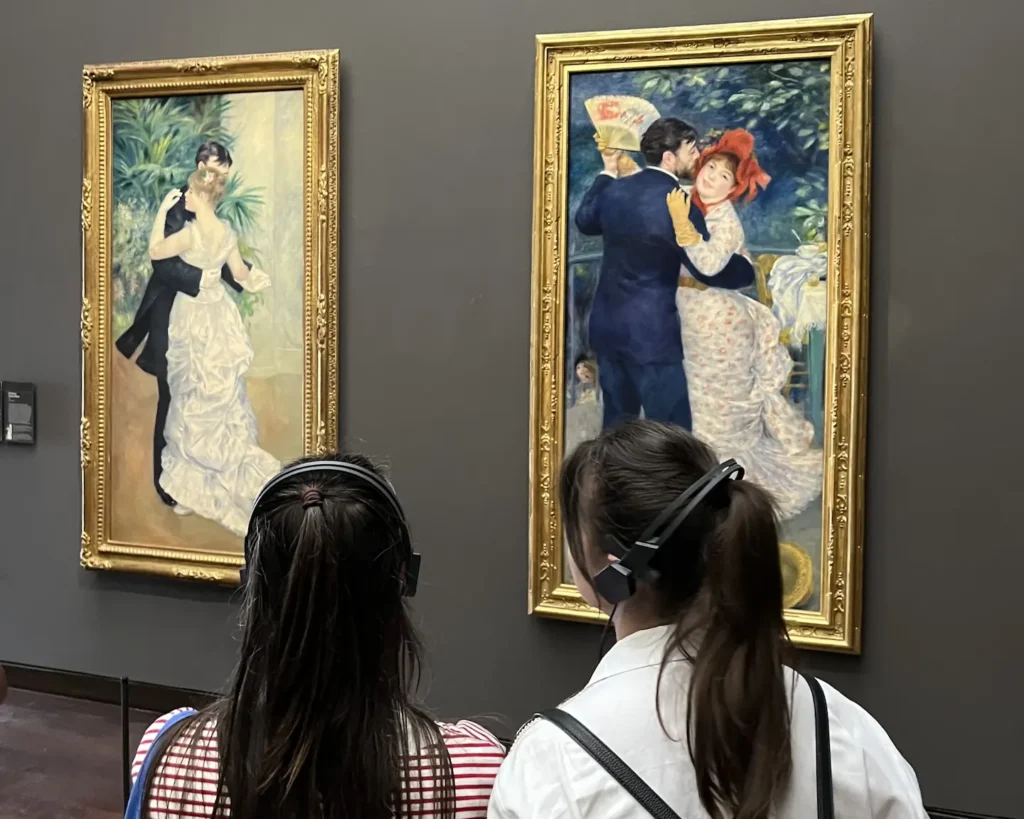
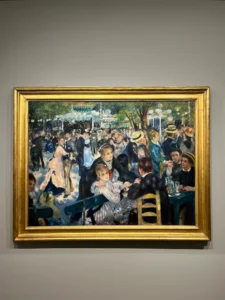
Think of Dance at the Moulin de la Galette, with Parisians twirling under the trees in Montmartre, or Luncheon of the Boating Party, with friends leaning in close to talk and laugh over food and wine by the Seine. These aren’t just happy pictures, they are vivid documents of a society discovering new freedoms.
Renoir painted the tenderness of parents with children, the energy of friends gathering in cafés, the intimacy of couples flirting in public spaces. The National Gallery explains it perfectly: “More than any of his contemporaries, Renoir was committed to chronicling love and friendship and their informal manifestations as keys to modern life.”
That is what makes Renoir and Love such a special exhibition. It’s not only about displaying beautiful art, it’s about showing Renoir as the painter of connection.
Renoir Exhibition Paris 2026: Renoir and Love at the Musée d’Orsay
17 March – 19 July 2026
The Musée d’Orsay is already one of the world’s best places for Impressionism, so it’s the perfect setting for this show. This will be the first major Renoir retrospective in France since 1985, which is remarkable considering how central he is to French culture.
More than fifty paintings will be gathered from museums and private collections worldwide. Works are coming from Copenhagen, Frankfurt, Stockholm, Los Angeles, Washington, and more. Just the logistics of bringing all of these together is extraordinary.
The highlights are dazzling. Dance at the Moulin de la Galette (1876), Renoir’s most famous celebration of Parisian leisure, will be there. Luncheon of the Boating Party (1881), with its laughter and sunlight, will also be on display. These paintings are not only beautiful, they capture a city discovering modern life, new freedoms, and new ways of being together.
The Musée d’Orsay points out that Renoir’s vision of love was wide. He didn’t just focus on flirtation, but also on families and the bonds of friendship. His art suggests that love, in all its forms, is the force that ties us to each other and to the world.
Tips from Artsy Trips. Give yourself at least ninety minutes for the Renoir exhibition, but don’t stop there. Add a couple of hours to wander through the Orsay’s permanent Impressionist collection, which is one of the finest in the world. When you step outside, cross the Pont Royal and pause for one of the loveliest views of the Seine and the Louvre.
For lunch, avoid the touristy riverfront and head to Rue de Lille just behind the museum. The cafés there are calmer, more local, and a wonderful way to stay in Renoir’s atmosphere of sociability.
Luncheon of the Boating Party in the Renoir Exhibition 2026
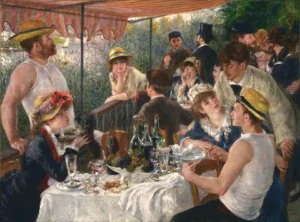
The Luncheon of the Boating Party by Renoir — often considered his most iconic work — will only be shown in Paris during the Renoir and Love exhibition.
The painting has been lent by The Phillips Collection and is currently on display at Musée d’Orsay from March 17 to July 19, 2026.
According to the museum, Luncheon of the Boating Party will not travel to London or Boston. After the Paris exhibition ends, it will return to Washington, D.C., where it is expected to be back on view at The Phillips Collection starting August 2026.
This means that if seeing this masterpiece is high on your list, Paris is the only destination where you’ll experience it as part of the 2026–2027 exhibition series.
Renoir Drawings Exhibition in Paris
17 March – 5 July 2026
Running alongside Renoir and Love will be Renoir Drawings. This smaller exhibition is a real treat, focusing on Renoir’s drawings, pastels, and watercolors.
Renoir was often seen as a colorist, but this show reveals his skill as a draftsman. There will be quick sketches, preparatory studies, and delicate works in sanguine chalk, the reddish medium he loved. Some 100 works from around the world will be exhibited there. Later artists like Bonnard and Picasso admired these drawings, and it’s easy to see why once you’re in front of them.
Pair this with the main show if you can. After the large canvases, it’s refreshing to see Renoir’s more intimate works. Looking at his drawings feels like being let into his sketchbook, a glimpse into his process and personality.
Renoir Exhibition London 2026–2027: Renoir and Love at the National Gallery
3 October 2026 – 31 January 2027
After Paris, the exhibition travels to London, and this is a big deal. The National Gallery hasn’t had a major Renoir exhibition in twenty years. More than fifty paintings will be on display, including Bal du Moulin de la Galette, which will be seen in the UK for the first time.
That alone is enough reason to go. Seeing such a famous work without leaving London is historic. But the exhibition will also show Renoir’s artistic evolution, from the light-filled brushstrokes of the 1870s to the more structured, classical style he embraced in the 1880s.
The National Gallery will also feature one of its own treasures, The Umbrellas (1881–85). Seen next to the international loans, it shows Renoir’s ability to combine spontaneity with careful planning.
Tips from Artsy Trips. The National Gallery itself is free to visit, but this special exhibition will be ticketed. Book as early as possible, especially if you plan to go on a weekend.
After you’ve seen Renoir, spend time in the Gallery’s Impressionist rooms, which are some of the best outside France. When you step out into Trafalgar Square, I recommend walking over to Covent Garden for a drink or dinner. It feels like the kind of lively setting Renoir himself might have enjoyed painting.
Renoir Exhibition Boston 2027: Final Chapter at the MFA
For American audiences, the good news is that Renoir and Love doesn’t stop in Europe. It will arrive at the Museum of Fine Arts in Boston from 20 February to 13 June 2027.
The MFA already has one of the strongest Impressionist collections in the United States. If you’re traveling for Renoir, also make time for the Isabella Stewart Gardner Museum, just a short walk away. It’s one of the most atmospheric museums in America, and a beautiful counterpart to Renoir’s vision of intimacy and connection.
Renoir Exhibition Tickets and Planning
- Paris (Musée d’Orsay): Renoir and Love, 17 March – 19 July 2026, Renoir Drawings, 17 March – 5 July 2026, full ticket price is €16. Purchase it from the official ticketing website.
- London (National Gallery): Renoir and Love, 3 October 2026 – 31 January 2027, ticket details to be announced.
- Boston (MFA): Renoir and Love, 20 February – 13 June 2027, ticket details to be announced.
Impressionist exhibitions sell out quickly. If you know your travel dates, grab tickets as soon as they go on sale.
Final Thoughts
If you are planning a cultural trip to Paris or London in 2026, put this exhibition on your list. Standing in front of Dance at the Moulin de la Galette in Paris or seeing it in London for the first time is the kind of moment that stays with you long after the trip ends.
And if you are in Paris in spring, don’t miss Renoir Drawings. The drawings and studies often reveal the artist most clearly, in lines that feel fresh and personal even today.
For me, this is already the art event of 2026. I can’t wait to walk into the Orsay, step into Renoir’s world, and feel for myself how he captured the fleeting beauty of love and life.
You may also like